Meridian — Milestone history (what we built and why)
This is the narrative record of product progress: every major milestone, what shipped, why it mattered, and how pieces fit together.
| Doc | Role |
|---|---|
| This file | Full story: motivation + design intent per milestone |
ship.md |
One-line status table + “what’s next” |
CHANGELOG.md |
Release-note detail per version |
ROADMAP.md |
Ordering of backlog (what’s left) |
V1_ROADMAP.md |
Detailed plans / DoD for remaining work |
PITCH.md |
What sales can claim (must match tagged releases) |
Last updated: 2026-07-10. Latest tagged: v0.9.3. v1.0 gate in progress (POC_REPORT, V1_GATE); features paused.
Product arc in one paragraph
Meridian is an L7 OpenAI-compatible inference gateway: apps talk to one endpoint; Meridian routes across self-hosted backends (vLLM, Ollama, etc.), adds reliability and observability, then grew into multi-tenant controls, India-focused compliance (PII), cost attribution, and deployable packaging—without becoming an inference engine and without requiring app code changes.
Guiding rules (from day one):
- Reliability + visibility for inference fleets
- Backend-agnostic (no deep engine hooks for core value)
- Opt-in enterprise features (defaults keep OSS/demo simple)
- Never log prompts by default; metrics avoid unbounded label cardinality
- One milestone ≈ one branch ≈ one PR ≈ changelog entry
Architecture (stable through all milestones):
Client → Meridian (FastAPI)
           │  auth / policy / budgets / PII / cost
           │  route (strategy + tier + affinity)
           │  proxy (stream passthrough)
           ▼
        Backend 1..N
Detailed diagram: assets/architecture_diagram.png
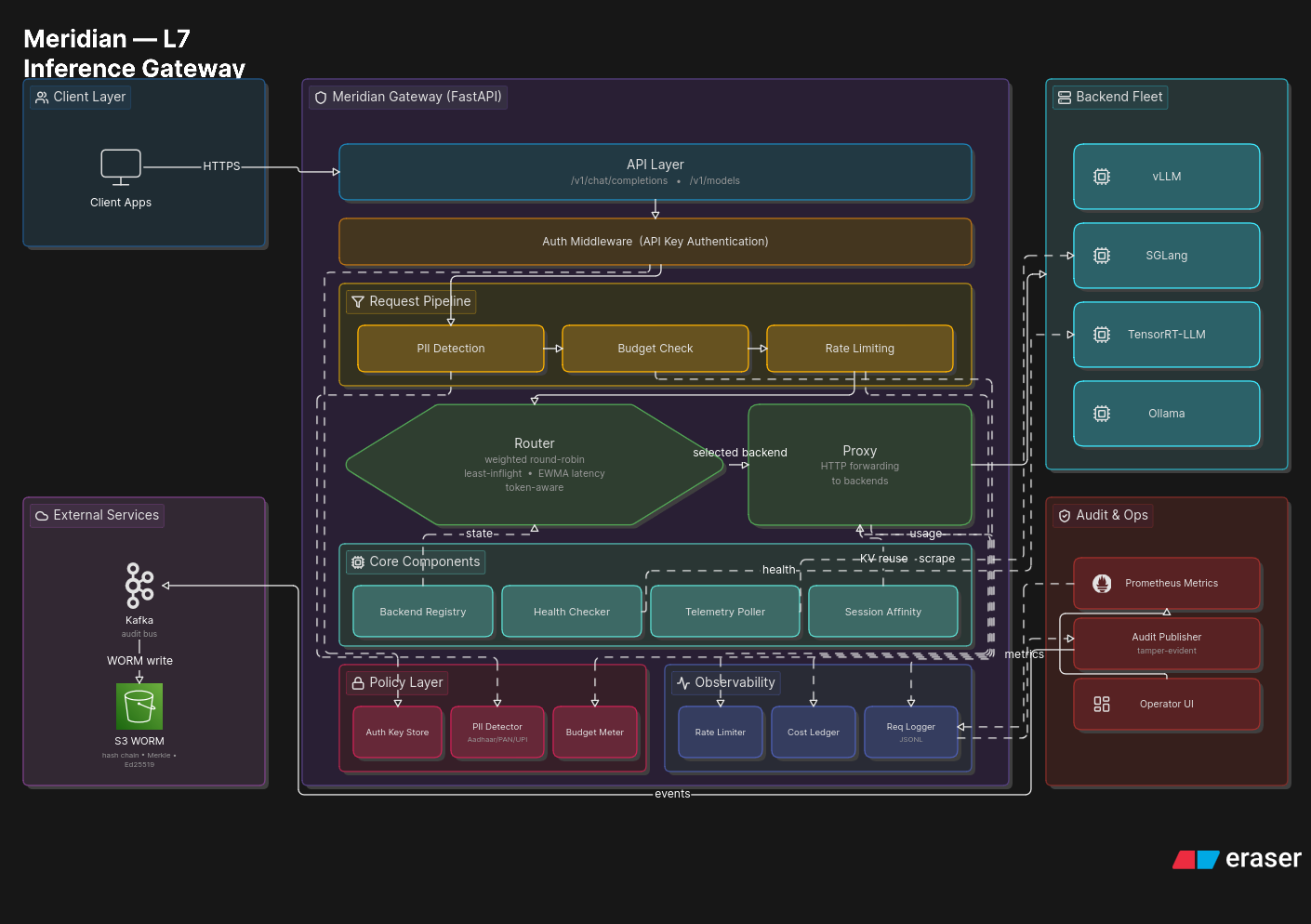
Post-refactor composition (before M/N landed on this shape):
| Module | Role |
|---|---|
meridian/api/state.py |
AppState — runtime deps |
meridian/api/pipeline.py |
Parse body + policy chain |
meridian/api/routing.py |
Tiering + session affinity + strategy |
meridian/api/finalize.py |
Sync teardown (stream-safe) |
meridian/api/main.py |
Thin HTTP routes + lifespan |
Core gateway — v0.1.0
What
- OpenAI-compatible
/v1/chat/completions(stream + non-stream) and/v1/models - Streaming SSE passthrough (no full-response buffering)
- Routing strategies: weighted round-robin, least inflight, EWMA latency
- Active health checks + passive failure detection → failover
- Prometheus metrics, metadata-only JSONL request logs
- Operator UI (
/ui), YAML config, Docker Compose demo with mock backends
Why
Teams already run inference servers. What they lack is a single production edge: one URL, health-aware routing, and operator visibility—without rewriting clients or binding to one engine.
Milestone A — Distribution — v0.1.1
What
- Multi-arch container images (amd64/arm64), release CI (GHCR; Docker Hub optional)
scripts/smoke_test.pyfor published images- Docker pull / run quickstart docs
Why
If install is hard, nothing else matters. “docker pull + config” is the adoption funnel for OSS and the reproducibility baseline for enterprise PoCs.
Milestone B — Token-aware routing — v0.2.0
What
- Strategy
token_aware: estimate prompt tokens +max_tokens, scoreestimated_cost * latency_factor(plus inflight cost on backends) - Heuristic token estimator; gateway knobs (
prefill_weight,decode_weight, …)
Why
Not all requests are equal. Mixing short and long generations on “least inflight” alone causes head-of-line blocking. Routing by estimated cost is the first inference-aware win that stays backend-agnostic.
Milestone C — Telemetry adapters — v0.2.1
What
meridian/telemetry/: JSON poll adapter for queue depth / GPU mem / tok-s- Capacity penalties on
token_aware(queue_weight,mem_weight) - Status + UI surfaces for capacity signals
- Invariant: telemetry tilts preference; health gates eligibility
Why
Gateway counters alone miss “healthy but overloaded.” Optional backend signals shift traffic before hard failures—still without engine-specific code.
Milestone D — Workload tiering — v0.3.0
What
- Map request shape → tiers:
long_prompt/long_decode/default - Select backends by tags; fallback to all healthy if a pool is empty
- Headers/logs:
x-meridian-tier
Why
Production-friendly prefill/decode-ish separation without true disaggregated serving: dedicate pools by request shape via config only.
Milestone E — KV-affinity lite — v0.3.1
What
- Optional session stickiness via
x-meridian-session(default header) - In-memory map, sliding TTL, max sessions, background sweep
- Remap if pinned backend is unhealthy;
x-meridian-session-route=new/pinned/remapped
Why
Continuations benefit from landing on the same backend (cache locality) without reading engine KV internals. Reliability still wins over stickiness on failover.
Side track — Tamper-evident audit pipeline
What
Optional async path: Kafka/Redpanda → SHA-256 hash chain → Merkle tree → Ed25519 signing → S3 Object Lock (WORM). Metadata-only events.
Why
Regulated buyers ask “can we prove logs weren’t tampered with?” This answers audit integrity, separate from day-to-day JSONL/Prometheus.
Milestone F — API-key authentication — v0.4.0
What
- Opt-in
auth.enabled; Bearer keysmrdn_…on/v1/* - Keys map to org / team / user identity
- OpenAI-shaped 401s;
/metrics,/meridian/*,/uileft open for ops plane
Why
Without identity, every later control (rate limits, budgets, cost, PII policy overrides) has nothing to hang on. Identity is the keystone.
Milestone G — Identity-aware logging — v0.4.0
What
- Attach
org_id/team_idto JSONL and audit events (never the raw key)
Why
Attribution and incident response need “which tenant,” not “which IP behind the LB.”
Milestone H — Per-org rate limiting — v0.4.0
What
- When authed, rate-limit key =
org:{org_id}(elseip:…) - Token bucket; later org overrides live under
rate_limit.org_overrides
Why
IP rate limits are meaningless behind a VPC load balancer. Tenants share a fair bucket regardless of source IP.
Milestone I — Model access control — v0.5.0
What
- Per-key
allowed_models; disallowed model → 403permission_error - Empty list = unrestricted; only when auth is on
- Identity field:
allowed_models(honest name; formerly overloadedscopes)
Why
Not every key should call every model (cost, safety, tiering). Config-only governance, no app changes.
Milestone J — Tenant budgets & quotas — v0.5.0
What
UsageMeter: SQLite (default for durability) + in-memory- Caps: tokens (via estimated
request_ctx.cost) + requests; daily/monthly; org → team → user cascade - Pre-flight
check_and_increment→ 429 +Retry-After - Chat order: access → (later PII) → budget → rate limit → route
so 403/budget denials don’t spend rate tokens - Metrics:
meridian_budget_rejections_total{level,period}only
Why
CFO / platform owners need hard spend/shape caps without parsing response bodies (preserves streaming zero-copy). Estimates are conservative by design; actuals come later (M).
Milestone K — Hardening — v0.6.0
What
- Bounded rate-limit store (idle TTL + max keys + eviction)
- Stream cancel safety: sync finalize; audit enqueue without await in
stream
finally; client disconnect → 499 /client_disconnect - Body size cap → 413 (
gateway.max_body_bytes) - Container: non-root user, HEALTHCHECK, slim bookworm base
- Version consistency checks in CI / release
Why
Before design-partner / enterprise load: no unbounded memory growth on RL maps, no lost audit/inflight on disconnect, no multi-GB POST DoS, no root container as default.
Milestone L — PII detection (India pack) — v0.7.0
What
meridian/pii/: Aadhaar (Verhoeff), PAN, GSTIN, IFSC, UPI, Indian mobile- Policies:
block|redact_and_replace|redact_for_logs|audit_only - Global + per-key
pii_policy - Matched values never logged — only type counts in JSONL/audit/metrics
- Request path only (response scanning deferred)
Why
Sovereign / regulated India deployments need prompt-side DLP-ish controls as a differentiator. Counts-only observability keeps the audit trail usable without storing secrets.
Architecture refactor (between L and M)
What
AppStateinstead of feature globals- Policy pipeline (
prepare_chat_request) - Routing / finalize modules; thin
main.py - Never forward client Meridian
Authorizationupstream; optionalbackends[].auth_header - Rate-limit org overrides moved off budgets onto
rate_limit.org_overrides - Ponytail cleanup: drop test shims and thin wrappers
Why
Milestones had stacked policy ifs into one god handler. Before cost
attribution and packaging, the composition layer had to stop growing spaghetti
so enterprise changes stay reviewable and safe.
Milestone M — Cost attribution — v0.8.0 (tagged)
What
- Opt-in
cost:: scrape actualusagefrom non-stream JSON and stream SSE tail (last 64KiB; last usage wins) - Ledger: memory or sqlite + WAL; per-model prices per 1M tokens
GET /meridian/usage+/meridian/usage.csv- Enterprise authz: usage APIs require auth when cost is on; refuse open
export if auth is off; non-admin org/team scoped;
cost_adminfor cross-org export - Prometheus:
meridian_tokens_total{model,kind}only (no org labels) - Ops checklist:
ENTERPRISE_COST.md
Why
Budgets answer “may this request run?” with estimates. Finance asks “what did we actually spend?” M records backend-reported tokens and priced cost without putting tenant IDs on high-cardinality metrics.
Explicit non-goals (still true)
- Full multi-provider SSE dialects
- Org labels on Prometheus (use usage API instead)
- Refund on upstream failure (estimate stays charged)
Milestone N — Deployment packaging — v0.9.0 (tagged)
What
- Helm chart
deploy/helm/meridian/(Deployment, Service, ConfigMap, PVC, optional keys Secret, non-root security context) - Air-gap
scripts/package_airgap.sh+AIRGAP.md - Ops
DEPLOY.md: TLS edge, backup/retention, sizing, rotation - Key hot-reload:
auth.keys_file; SIGHUP orPOST /meridian/reloadwithops_adminkey; atomickey_indexswap docs/MILESTONES.mdnarrative history
Why
A 1-hour PoC / air-gapped bank install cannot depend on “clone and hope.” Packaging + key rotation without full restarts are table stakes once real users are on the gateway.
After N — 0.9.x product completion (not v1.0 yet)
v1.0 is deferred until the product is complete for multi-tenant enterprise use (including the ~1000-user class deployment). Continue patch/minor 0.9.x:
| Version | Intent |
|---|---|
| 0.9.1 | Shipped — enterprise template, /meridian/version, hard cost↔auth gate, Helm CI |
| 0.9.2 | Shipped — budget↔actual token-meter reconcile after backend usage |
| 0.9.3 | Shipped — load/overhead, deeper e2e + CI smoke, ops polish |
| Ollama proof | Real-path numbers in LOAD.md (post-0.9.3 docs) |
| v1.0 | Next — design-partner PoC evidence + pitch honesty gate only |
0.9.2 — Budget ↔ actual reconcile
What
- Pre-flight still reserves on
request_ctx.cost(estimate). - On successful responses with OpenAI-style
usage, computeactual = prompt_tokens * prefill_weight + completion_tokens * decode_weightandUsageMeter.adjust(keys, actual - estimate)for token keys only. - Clamp consumed ≥ 0; do not re-check caps on adjust (request already ran).
- Request counters unchanged; upstream failures keep the estimate charge.
- Usage scrape when cost or budgets need actual tokens (budgets no longer
depend on
cost.enabledfor scrape). - Metric:
meridian_budget_reconciles_total{direction=over|under|equal}.
Why
Estimate-only budgets drift under real mixed traffic (short vs long generation). Reconcile keeps enforcement honest without parsing the full stream body (still tail-scrape / non-stream JSON only).
0.9.3 — Load numbers, richer e2e, ops polish
What
- Load:
scripts/bench_overhead.py+LOAD.md— ~0.7 ms p50 serial overhead on mock path; sizing guidance for concurrent streams - E2E: enterprise suite (auth, budgets, cost, stream, failover) + CI
gateway-smoke(live mock + Meridian + smoke script) - Ops:
x-meridian-budget-remaining-tokens|requests;OPS_RUNBOOK.md; retention/headers inDEPLOY.md
Why
Operators sizing a ~1k-user fleet need published overhead, a CI-backed smoke path that exercises multi-tenant features, and day-2 runbook defaults.
Dependency picture (shipped)
Core + A (run anywhere)
   → B,C (smarter routing)
   → D,E (pools + stickiness)
   → Audit pipeline (optional integrity)
   → F,G,H (identity)
   → I,J (governance)
   → K (safe to expose)
   → L (compliance differentiator)
   → refactor (composition)
   → M (finance actuals)
   → N (install & rotate keys)
   → v1.0 = PoC proof + pitch honesty, not a feature dump
Version / tag map
| Tag | Milestones |
|---|---|
v0.1.0 |
Core |
v0.1.1 |
A |
v0.2.0 |
B |
v0.2.1 |
C |
v0.3.0 |
D |
v0.3.1 |
E |
v0.4.0 |
F, G, H |
v0.5.0 |
I, J (changelog; confirm tags in your registry) |
v0.6.0 |
K |
v0.7.0 |
L |
v0.8.0 |
M |
v0.9.0 |
N |
v0.9.1 |
Product-complete polish |
v0.9.2 |
Budget↔actual reconcile |
v0.9.3 |
Load numbers, e2e, ops polish |
Always prefer git tags + CHANGELOG over pyproject alone for “what is
in production.”